


Writer by:
Muhammad Farid Wajdi 1), Hasaruddin 2) *)
Studi Pascasarjana Program Dirasah Islamiyah Konsentrasi Sejarah Peradaban Islam
UIN Alauddin Makassar
Email: mfarid.wajdi@immimpangkep.ponpes.id 1), hasaruddin@uin-alauddin.ac.id 2)
Abstract
The book Nūr al-Yaqīn fī Sīrat Sayyid al-Mursalīn by Shaykh Muhammad al-Khudari Bik is a modern Islamic historiographical work that holds a crucial position in the tradition of studying the Prophetic Biography (Sīrah Nabawiyah) across various Islamic institutions. Although written in the early twentieth century, this book exhibits transitional characteristics that bridge classical narrative methodology (riwāyah) with modern rational-analytical tendencies (dirāyah). This study aims to dissect the epistemology of writing the Sīrah Nabawiyah in the aforementioned book through a critical historiographical approach. The focus of the study is directed at three main dimensions: the epistemological sources utilized, the textual criticism methods (naqd al-hadīth wa al-āthār) applied by the author, and the ideological and theological structures influencing its historical narrative. Utilizing a qualitative research method based on library research, this study concludes that al-Khudari Bik adopts an integrative epistemology. He maintains the rigidity of the chain of transmission (sanad) from the classical tradition—relying primarily on Sahih al-Bukhari and Muslim—while simultaneously undertaking structural simplification for didactical-pedagogical purposes. This establishes the work as a transitional model of historiography that attempts to purify the sīrah narrative from weak traditions (da‘īf) and biblical-judaic interpolations (isrā’īliyyāt) without losing its theological spirit.
Keywords: Epistemology, Sīrah Nabawiyah, Nūr al-Yaqīn, Islamic Historiography, Muhammad al-Khudari Bik.
I. Introduction
A. Background of the Study
The historiography of Prophet Muhammad’s life, specifically conceptualized as the tradition of Sīrah Nabawiyah, constitutes one of the fundamental pillars in the reconstruction of Islamic civilization. The Sīrah Nabawiyah is not merely a chronological recording of past occurrences; rather, it represents a theological-historical manifestation that functions as a contextual exposition of the Qur’an and the ideal path of life (sunnah) that Muslims are obligated to emulate.[1]
Consequently, since the early centuries of the Hijri calendar, pioneering Muslim historians such as Urwah bin al-Zubayr and Ibn Shihab al-Zuhri, culminating in the seminal works of Ibn Ishaq and Ibn Hisham, formulated a rigorous transmission methodology to safeguard the authenticity of such historical accounts.[2]
This nascent tradition was profoundly influenced by the methodology of the traditionists (muḥaddithīn), wherein the validity of a historical event was strictly contingent upon the continuity of the chain of transmission (sanad) and the credibility of the transmitters (jarḥ wa al-ta‘dīl).[3]
Over time, however, the domain of Islamic historiography underwent a methodological polarization. On one hand, a textual-traditionalist tendency emerged, which accumulated all available narrations without performing a rigorous rational filtration regarding the textual content (matan). On the other hand, upon entering the modern era in the nineteenth and twentieth centuries, the wave of secularization and the challenges posed by Western Orientalism compelled the reconstruction of the sīrah to appear more rational, causal, and sociological.[4]
It was precisely at this methodological crossroads that the book Nūr al-Yaqīn fī Sīrat Sayyid al-Mursalīn by Shaykh Muhammad al-Khudari Bik (1872–1927 CE) emerged. Authored by an Egyptian scholar, historian, and sharia judge who lived during the era of intellectual awakening (al-Nahḍah), this work rapidly attained an esteemed position within the world of Islamic education.[5]
Al-Khudari Bik composed this work out of a tangible epistemological anxiety: he observed that the sīrah textbooks circulating during his time were frequently rife with unauthentic narrations, groundless mystical fables (khurāfāt), and the influence of Biblical-Judaic interpolations (isrā’īliyyāt) that threatened to obscure the core prophetic essence of Prophet Muhammad SAW as a rational and exemplary role model (uswatun ḥasanah).[6]
Epistemologically, Nūr al-Yaqīn offers a distinct uniqueness within the landscape of Islamic historiography. Al-Khudari Bik executed a narrative purification project (taṣḥīḥ al-narāsī) by establishing exceptionally stringent source standardization. He explicitly declared in his introduction that he solely relied on the Qur’an and authoritative books of Hadith—specifically Ṣaḥīḥ al-Bukhārī and Ṣaḥīḥ Muslim—before subsequently referencing classical sīrah texts like the work of Ibn Ishaq, provided they did not conflict with the principles of Hadith authenticity.[7]
This step represented an epistemological leap, as he attempted to wed the rigidity of Hadith criticism with a systematic, chronological, and accessible historical narrative tailored for both the general public and students of knowledge (didactic-pedagogical).[8]
Nevertheless, al-Khudari Bik’s methodology is not devoid of academic problems when dissected through the lens of modern historical epistemology. The didactical-pedagogical nature of this book consequently led to the omission of the entire sanad structure within the main text. Readers are merely presented with the finished product of a historical conclusion without being shown the profound dialectical process of textual criticism within the text itself.
Furthermore, as a scholar living under the shadow of Islamic modernism in Egypt—which was heavily influenced by figures such as Muhammad Abduh—there is a noticeable tendency to reduce certain supernatural events (miracles) in order to present a prophetic figure more acceptable to modern rationality, even though he consistently maintained the orthodox Ash’arite creed (‘aqīdah) that he adhered to.[9]
Previous literature regarding the Sīrah Nabawiyah has generally been trapped between two extremes: examining the sīrah purely from a theological-normative perspective, or analyzing it from a secular positivistic-historical viewpoint that completely negates the prophetic dimension. Studies that specifically dissect the epistemological anatomy of Nūr al-Yaqīn as a product of transitional historiography remain severely limited. Most existing research merely positions this book as a standard curriculum textbook (kitab daras) in Islamic boarding schools (pesantren) or madrasahs without questioning how the historical knowledge within it was produced, validated, and justified by its author.[10]
Therefore, a profound study concerning “The Epistemology of Writing the Prophetic Biography in Nūr al-Yaqīn fī Sīrat Sayyid al-Mursalīn” becomes highly relevant and urgent. Through this critical examination of Islamic historiography, we will not only comprehend the intellectual framework of Muhammad al-Khudari Bik, but also map out how the Muslim intellectual mind at the turn of the twentieth century responded to modernity, conducted internal critiques against its classical heritage (turāth), and reformulated the methodology of writing sacred history so that it remained relevant without losing its vital theological elan.
B. Research Questions
Based on the background of the study outlined above, the research questions in this study are formulated as follows:
What are the epistemological sources (maṣādir al-ma‘rifah) utilized by Shaykh Muhammad al-Khudari Bik in compiling the book Nūr al-Yaqīn fī Sīrat Sayyid al-Mursalīn?
How are the textual criticism methods (naqd al-nuṣūṣ) and historical validation mechanisms applied by al-Khudari Bik toward controversial or weak (ḍa‘īf) classical sīrah narrations?
What are the historiographical characteristics of the book Nūr al-Yaqīn within the context of the dialectic between the classical narrative tradition (riwāyah) and the demands of modern rationality (dirāyah)?
C. Research Objectives
The specific objectives to be achieved through the writing of this scientific article are:
To analyze and map out the epistemological sources that construct the historical narrative framework in the book Nūr al-Yaqīn fī Sīrat Sayyid al-Mursalīn.
To deconstruct and evaluate the textual criticism methods as well as the historical validation mechanisms operated by al-Khudari Bik in filtering historical narrations.
To identify and categorize the historiographical characteristics of the book Nūr al-Yaqīn as a representation of a modern transitional Islamic historiographical model.
D. Significance of the Study
This study is expected to provide both theoretical and practical contributions as follows:
1. Theoretical Significance
Development of Islamic Epistemology
The results of this study are expected to enrich the treasury of Islamic thought, particularly in the branch of historical epistemology (Islamic historiography), by providing clarity on how revelatory data (hadith) and empirical-historical data are integrated within a literary work.
Historiographical Criticism
To offer an academic contribution to the study of textual criticism regarding modern sīrah works, thereby serving as a theoretical foundation for subsequent researchers of Islamic history in evaluating twentieth-century historical writing methodologies.
2. Practical Significance
For Educational Institutions
To provide a more philosophical methodological insight for educators and students (santri) in Islamic educational institutions (such as Pesantren and Madrasahs) that utilize the book Nūr al-Yaqīn, enabling them to not only memorize historical texts but also comprehend the critical reasoning behind their compilation.
For Religious History Writers
To serve as a reference and methodological guide for contemporary historians in constructing religious narratives that are objective and scientific, yet remain sensitive to the theological nuances of the Muslim community.
II. Research Method
A research method serves as a methodological compass that guides the course of a scientific inquiry, ensuring its epistemological accountability.[11] To dissect the anatomical and intellectual framework of Shaykh Muhammad al-Khudari Bik in his work Nūr al-Yaqīn fī Sīrat Sayyid al-Mursalīn, this study is designed as a qualitative research. The primary characteristic of qualitative research within historical and historiographical studies is its emphasis on meaning, context, and the in-depth interpretation of texts (thick description), rather than generating numerical or statistical generalizations.[12]
Given that the material object of this study is a classic-modern literary work, the specific research type employed is library research. Library research is not merely the act of collecting, reading, and recording reference books; rather, it is a scientific method involving critical reasoning to analyze texts, ideas, and concepts captured within literature to resolve an academic problem.[13]
A. Research Approaches
In peeling back the epistemological layers of the book Nūr al-Yaqīn, this study applies three integrating, multidisciplinary approaches:
1. Critical Historiographical Approach
This approach is utilized to examine how al-Khudari Bik wrote history. Through this lens, history is not viewed as a frozen landscape of objective facts, but rather as a construction of knowledge influenced by methodology, zeitgeist (the bias of the era), and the intellectual background of the historian.[14]
2. Epistemological Approach
This is applied to trace the originality and validity of the produced historical knowledge. The focus lies in examining the sources of knowledge (maṣādir al-ma‘rifah), the data processing methods (manhaj al-baḥth), and the criteria of truth (mi‘yār al-ḥaqīqah) adopted by the author.[15]
3. Historical Hermeneutical Approach
Considering that the text was produced in early twentieth-century Egypt—a crucial phase of intellectual awakening—hermeneutics helps the researcher capture the author’s intent (intentio auctoris) by dialoguing it with the socio-historical context in which the text was born (Sitz im Leben).[16]
B. Data Sources
As a library research, the data in this study is entirely documentary, sourced from the treasury of literature. The data sources are classified into two main categories:
1. Primary Data Source
The main source serving as the direct material object of this study is the original text of the book Nūr al-Yaqīn fī Sīrat Sayyid al-Mursalīn by Shaykh Muhammad al-Khudari Bik, specifically an authoritative edition containing the author’s original introduction, as it explicitly outlines the book’s methodological blueprint.[17]
2. Secondary Data Sources
These encompass all relevant supporting literature that aids the researcher’s analytical tools. This includes other works by al-Khudari Bik—such as Tārīkh al-Umam al-Islāmiyyah and Tārīkh al-Tasyrī‘ al-Islāmī—to evaluate his methodological consistency. Additionally, secondary sources include books on modern Islamic historiography (the works of Tarif Khalidi, Badri Yatim, etc.), scientific journals concerning the epistemology of Islamic history, and the intellectual biography of al-Khudari Bik.[18]
C. Data Collection Technique
Data collection in this study is conducted through a documentary study technique. The researcher acts as the primary instrument (human instrument) to systematically trace, read, classify, and record the literary data.[19]
This exploration of library data begins with the editing and organizing of data, wherein the researcher performs a macro-reading (skimming) of Nūr al-Yaqīn to map out clusters of controversial historical events (such as the splitting of the Prophet’s chest or the Isrā’ Mi‘rāj). Following this, an in-depth micro-reading (close reading) is executed to extract data regarding how al-Khudari Bik treated the text, eliminated weak narrations, and constructed his historical narrative.[20]
D. Data Analysis Technique
Once the library data is collected and verified, data analysis is performed qualitatively and inductively using Critical Content Analysis. The steps of textual analysis are carried out through the following scientific procedure:
[Textual Reduction] ➔ [Epistemological Categorization] ➔ [Methodological Comparison] ➔ [Drawing Conclusions]
- Textual Reduction
Selecting specific sections from the book Nūr al-Yaqīn that clearly demonstrate the author’s methodological operations (e.g., phrases rejecting certain narrations or justifications for utilizing authentic hadiths).
- Epistemological Categorization
Grouping the data into the structure of Islamic epistemology: determining which elements fall into the domains of bayānī (textual authority), ‘irfānī (intuition/sufism), or burhānī (reason/historical causality).[21]
- Methodological Comparison
Comparing the narrative in Nūr al-Yaqīn with classical sīrah texts (such as Sīrah Ibn Hisyām) to concretely observe which narrations were pruned or maintained by al-Khudari Bik.
- Drawing Conclusions (Justification)
Interpreting the entirety of the findings to formulate an objective, final synthesis regarding the historiographical characteristics of the book.
III. Results and Discussion
The epistemological anatomy of any historiographical work invariably encapsulates the intellectual blueprint of the historian as well as the contemporary dialectics surrounding them. When Shaykh Muhammad al-Khudari Bik compiled Nūr al-Yaqīn fī Sīrat Sayyid al-Mursalīn at the turn of the twentieth century, he was by no means writing within a cultural vacuum. Egypt at that time was the epicenter of an intellectual struggle between the wave of Islamic modernism (al-Nahḍah) spearheaded by Muhammad Abduh and Rashid Rida, and the institutional traditionalism anchored at al-Azhar.[22] This Sitz im Leben context is highly crucial to comprehend, as it directly molded the architecture of al-Khudari Bik’s epistemological framework in redefining, filtering, and re-presenting the sacred history of Prophet Muhammad SAW to a modern Muslim society.
A. Epistemological Sources (Maṣādir al-ma‘rifah) of the Book Nūr al-Yaqīn
Within the discourse of Islamic epistemology, sources of knowledge are generally classified into three primary domains: bayānī (revelatory texts/religious authority), burhānī (reason and empirical causality), and ‘irfānī (intuition/unveiling).* [23] In Nūr al-Yaqīn, al-Khudari Bik predominantly operates within a bayānī epistemology that has undergone purification and has been integrated to a limited degree with burhānī reasoning. The uniqueness of this book lies in the restructuring of the hierarchy of sources that he applied to the composition of the prophetic biography.
Prior to the twentieth century, it was common to encounter classical sīrah works that compiled all historical accounts across varying degrees of textual quality. The classical historian Ibn Jarir al-Tabari, for instance, applied the principle of narrative accumulation (riwāyah) by incorporating entire chains of transmission (sanad) without exercising rigorous censorship over the textual content (matan), thereby leaving the final assessment to the discernment of the reader.[24]
Conversely, al-Khudari Bik broke away from this accumulative tradition, replacing it with a selective-exclusive method. In his introduction, he asserts his epistemological declaration regarding the primary foundations he relied upon, “I have compiled this book by relying upon the Noble Qur’an, as it is the most authentic source whose truth is beyond doubt. This is followed by the authentic books of Hadith, specifically the collections of al-Bukhari and Muslim, and subsequently the earlier books of sīrah that have been recognized for their scholarly integrity…”[25]
Based on this assertion, the structured epistemological hierarchy governing al-Khudari Bik’s sīrah writing can be mapped out as follows:
[1. The Noble Qur'an] ➔ [2. Sahih al-Bukhari & Muslim] ➔ [3. Authoritative Sunan & Musnad] ➔ [4. Selected Classical Sīrah Books]
- The Qur’an as the Primary Historical Foundation, For al-Khudari Bik, the Qur’an is not merely a book of law or theology, but the most authentic primary historical document. He uses Qur’anic verses to regulate and verify the validity of external, evolving sīrah accounts. If a sacred historical event is exaggerated within classical sīrah texts but contradicts the textual indications of the Qur’an, al-Khudari Bik gives absolute precedence to the Qur’an.[26]
- The Authority of the Shaḥīḥayn, The most prominent characteristic of Nūr al-Yaqīn is the subordination of the historical narrative to the methodology of the traditionists (muḥaddithīn). Al-Khudari Bik treats Ṣaḥīḥ al-Bukhārī and Ṣaḥīḥ Muslim as a second-layer epistemological filter. In doing so, he shifted the locus of sīrah writing—which previously relied heavily on the Maghāzī works of Ibn Ishaq or al-Waqidi (frequently criticized by traditionists for their laxity in accepting narrations)—toward hadith texts that have passed the most rigorous sanad evaluation within the Islamic tradition.[27]
- Classical Sīrah Works as Chronological Complements, Al-Khudari Bik does not entirely discard classical sīrah literature such as Sīrah Ibn Hisyām or Tārīkh al-Tabarī. Rather, he places them at the lowest tier of his source hierarchy. These classical works are strictly employed to fill in chronological gaps and provide geographical or genealogical details left unspecified within the authentic books of hadith.[28]
Through this deliberate arrangement of the source hierarchy, al-Khudari Bik succeeded in establishing a corrective epistemological model (tashīḥ). This step radically severed the Sīrah Nabawiyah narrative from the grip of fabricated accounts, entertaining fables, and the elements of Biblical-Judaic interpolations (isrā’īliyyāt) that had crept into Islamic history books over centuries due to the methodological laxity of past historians.[29]
B. Textual Criticism Methods (Naqd al-Nuṣūṣ) and Historical Validation Mechanisms
Having demarcated the boundaries of his sources, al-Khudari Bik operated historical data validation through mechanisms of internal criticism and external criticism. Within the Islamic scholarly tradition, this blends seamlessly with the science of Hadith criticism (naqd al-hadīth), encompassing the examination of both the sanad (chain of transmission) and the matan (textual content).[30] However, for didactic-pedagogical purposes—given that this book was initially projected as a textbook for students in Egyptian schools—al-Khudari Bik introduced a bold structural modification.
He excised the entire length of long sanad chains at the beginning of each narrative, directly offering his conclusions in a narrative-chronological format. In the modern academic world, this action raises a critical question: How can readers verify the validity of al-Khudari Bik’s historical claims if the primary verification instrument (the sanad) has been removed from the text?
The answer lies in the way al-Khudari Bik shifted sanad authority from the level of individual texts to the level of the text’s source institution. Whenever al-Khudari Bik details an event, he frequently concludes with a brief footnote or an explicit statement such as: “Diriwayatkan oleh al-Bukhari” (Narrated by al-Bukhari) or “Ini adalah kesepakatan ahli hadis” (This is the consensus of the traditionists). Consequently, historical validation in Nūr al-Yaqīn no longer depends on an independent process of jarḥ wa al-ta‘dīl (biographical evaluation of narrators) performed by the reader, but rather relies on the methodological consensus (ijmā‘) established among authoritative hadith scholars.[31]
Furthermore, al-Khudari Bik applies a highly engaging method of textual criticism (matan criticism) when confronting narrations that appear contradictory or illogical. He deploys three primary strategies in processing historical material:
1. The Method of Al-Jam‘u wa al-Tawfīq (Harmonization)
Where two narrations are equally authentic in terms of sanad but differ in situational details, al-Khudari Bik seeks a rational middle ground between the two without needing to discard either. For instance, in determining the duration of the Prophet’s stay in Mecca post-bi‘thah (prophethood), he harmonizes varying hadith accounts by clarifying the context of leap year calculations or numerical rounding by the Companions.[32]
2. The Method of Al-Tarjīḥ (Selective Elimination)
If harmonization is impossible due to a sharp contradiction, al-Khudari Bik chooses the most authentic and chronologically logical narration, while the weak (ḍa‘īf) account is instantly eliminated from the book without any need to debate its sanad.[33] This is highly evident in his decision to prune legendary pre-prophetic stories, such as the collapse of Khosrow’s palace or the extinguishing of the Magians’ eternal fire on the night of the Prophet’s birth, accounts frequently found in traditional sīrah works like those of al-Yaqubi or al-Diyar bakri. For al-Khudari Bik, such narrations lack a robust sanad and risk undermining the rationality of the sīrah.[34]
3. Demythologization of Historical Narrative
As an intellectual living in the modern era, al-Khudari Bik possessed a keen sensitivity toward public rationality. Consequently, he tended to reduce or re-interpret narrations containing excessive supernatural elements beyond the primary miracle of the Prophet (the Qur’an). In expounding upon the splitting of Prophet Muhammad’s chest (syaqq al-ṣadr) during his childhood under the care of Halimah al-Sa‘diyyah, al-Khudari Bik includes the event because of its status within Ṣaḥīḥ Muslim. However, he presents it in a straightforward language, refrains from unauthentic, fantastic details, and immediately draws its spiritual meaning as a divine purification process from negative human traits, rather than an eccentric medical-magical surgical procedure.[35]
Through these critical methods, al-Khudari Bik successfully presents a Sīrah Nabawiyah stripped of chronological distortions and superstition, transforming it into a historical framework that possesses a high degree of academic certainty (historical certainty) within the corridors of traditional Islamic scholarship.
C. Historiographical Characteristics of the Book Nūr al-Yaqīn: Between Riwāyah and Dirāyah
Theoretically, Islamic historiography progresses from the riwāyah phase (pure transmission of reports based on memorization and quotation) toward the dirāyah phase (critical analysis of the meaning, causality, and social implications of historical events).[36] Based on a critical content analysis of the text of Nūr al-Yaqīn, this work can be neatly categorized as a product of Modern Transitional Historiography. The book stands firmly with one foot planted in the orthodox, classical riwāyah tradition, while its other foot steps into the analytical domain of modern dirāyah.
To observe these transitional characteristics comprehensively, we can contrast the methodological structure of Nūr al-Yaqīn with the primitive classical historiographical model (such as Sīrah Ibn Hisyām) and the modern-rationalistic secular historiographical model (such as Ḥayāt Muḥammad by Muhammad Husain Haikal) through the following analytical table:
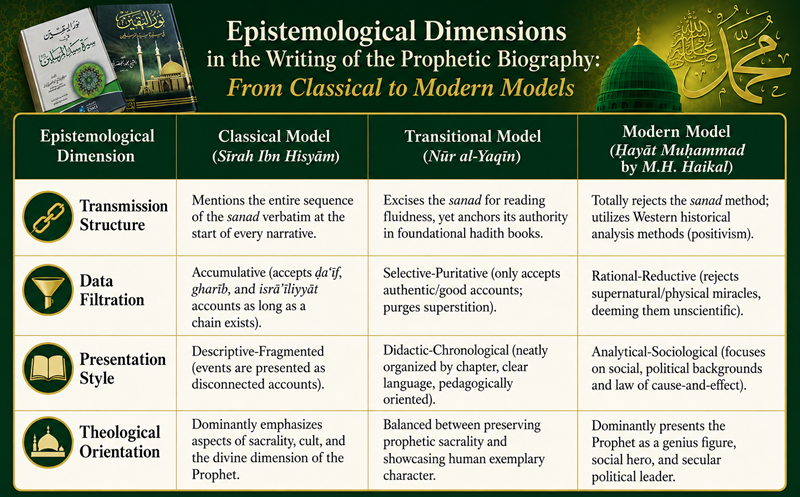
The table above brilliantly illuminates the moderate (tawassuṭ) position assumed by al-Khudari Bik. He does not slide into extreme traditionalism that accepts all forms of religious myth without screening, nor is he swept away by the radical modernism of Haikal or Taha Husain, who tended to idolize Western rationality to the point of devaluing physical miracles and the transcendental aspects of the Messenger of Allah’s life.[37]
The most prominent and defining characteristic of Nūr al-Yaqīn’s historiography is its didactic-pedagogical dimension. Al-Khudari Bik, whose background included serving as a lecturer of Islamic history at Cairo University (Al-Jāmi‘ah al-Miṣriyyah) and elite Egyptian madrasahs, deliberately designed the structure of this book to be easily digested by the minds of young Muslims starting to engage with modern educational systems.[38] Every chapter is given a thematic title, the chronological timeline progresses systematically from year to year according to the Hijri calendar, and at the end of several crucial historical fragments, al-Khudari Bik frequently inserts brief reviews regarding wisdom, deducible legal rulings (istanbāṭ al-aḥkām), or moral reflections.[39]
Nevertheless, from the standpoint of modern historical methodology, this hyper-didactic historiographical characteristic gives rise to its own epistemological vulnerability. By focusing too intensely on presenting a clean and smooth narrative for instructional purposes, al-Khudari Bik frequently overlooks deep sociological causality analysis. He tends to view historical shifts during the Prophet’s era as occurring purely due to direct divine intervention or the personal decisions of an infallible Prophet, without adequately exploring the economic dynamics, Arab tribal structures, and macro-geopolitical dialectics around the ancient Near East (between the Byzantine and Sasanian Empires) that also influenced the acceleration of Islamic dawah.[40]
D. Theological and Ideological Implications in the Historical Narrative
Every composition of religious history is essentially a form of historicized theology. The epistemology of al-Khudari Bik’s sīrah writing in Nūr al-Yaqīn was guided by a profound religious commitment to protect the prophetic image of Prophet Muhammad SAW (‘iṣmatul anbiyā’) from two massive external assaults in the early twentieth century: Western Orientalism and Christian missionary movements.[41]
Orientalists of that era, such as William Muir and Margoliouth, aggressively attacked the originality of Islam by fabricating narratives that Muhammad SAW was an epileptic subject experiencing hallucinations, or a power-hungry leader who spread religion by the sword.[42] In responding to this ideological challenge, al-Khudari Bik utilized his epistemological reasoning to construct the persona of Prophet Muhammad SAW as a sublime, highly moral, rational figure who brought a mission of peace and universal social justice.
This is highly visible in the chapters detailing the Prophet’s battles (ghazawāt). Al-Khudari Bik does not present war in Islam as an offensive action for territorial expansion or religious compulsion, but rather as a defensive act (difa’an ‘an al-nafs) to protect human rights and the freedom of belief oppressed by the Quraysh of Mecca.[43] He analyzes the motives behind every military expedition through a rational-legalistic lens, demonstrating that Muslims were consistently in a position of self-defense or responding to violations of peace treaties committed by enemy forces.[44]
Theologically, al-Khudari Bik also consistently maintains the boundaries of the Ash’arite creed. When dealing with verses or hadiths describing anthropomorphic traits of Allah or the physical involvement of angels in battle (such as the Battle of Badar), he presents them through the approach of tafwīḍ (consigning the meaning to Allah) or exercises a respectful ta’wīl (metaphorical interpretation), ensuring it does not trigger theological misconceptions among modern readers.[45] The historical narrative in Nūr al-Yaqīn thus functions as a sophisticated religious apologia: it is scientific because it relies on authentic hadiths that have passed rigorous filters, yet it simultaneously remains a robust ideological bastion that safeguards the sanctity and absolute truth of Islamic teachings from the deconstruction of Western modernity.
IV. Conclusion and Suggestions
A. Conclusion
Based on the comprehensive critical analysis and discussion presented in the preceding chapters regarding the philosophy and epistemological structure of the book Nūr al-Yaqīn fī Sīrat Sayyid al-Mursalīn by Shaykh Muhammad al-Khudari Bik, this study draws several fundamental conclusions as follows:
1. An Integrative and Puritative Epistemological Structure
Shaykh Muhammad al-Khudari Bik constructed the historical narrative of Prophet Muhammad SAW upon a highly rigorous foundation of bayānī epistemology (textual authority), which was proportionally harmonized with burhānī reasoning (rational-causality). He radically revolutionized the hierarchy of sources in sīrah writing by positioning the Qur’an and authoritative books of Hadith (Ṣaḥīḥ al-Bukhārī and Ṣaḥīḥ Muslim) as the primary filters. This purification process successfully cleansed the historical stage of the Prophet from the distortions of weak narrations (ḍa‘īf), groundless superstitions (khurāfāt), and the infiltration of Biblical-Judaic interpolations (isrā’īliyyāt) that frequently obscured the balance between the Prophet’s human and prophetic dimensions.
2. A Didactic-Pedagogical Transitional Methodology
Methodologically, Nūr al-Yaqīn represents a model of Modern Transitional Historiography. The book severed the convoluted chains of traditional narratives by omitting the entire sequence of transmission chains (sanad) to facilitate reader comprehension (a didactic orientation). Historical validation was shifted from independent sanad criticism to the institutional authority of consensus (ijmā‘) among hadith scholars. Al-Khudari Bik maintained a moderate (tawassuṭ) stance: he rejected the extreme traditionalism that absorbed accounts without screening, yet he simultaneously insulated his work from radical modernism that reduced the transendental prophetic dimension merely to satisfy Western positivistic rationality.
3. Apologetic and Ideological Functions
The composition of Nūr al-Yaqīn was inextricably linked to the socio-political dynamics of early twentieth-century Egypt, which was under intense pressure from Orientalist and missionary narratives. Epistemologically, al-Khudari Bik reconstructed the military history (ghazawāt) and life of the Prophet to project a figure who was rational, defensive, humanist, and a champion of universal justice. This historical narrative served a dual purpose: as a scientific framework for religious pedagogical material and as a theological fortress (upholding the Ash’arite creed) responding to modernity.
B. Suggestions
Based on the findings of this historiographical study, several academic suggestions are proposed for the future development of Islamic historical studies:
1. For Researchers of Islamic Historiography
Future studies should look to conduct more specific textual, chapter-by-chapter comparative analyses between Nūr al-Yaqīn and modern sīrah works written after it (such as the works of Said Ramadan al-Buti or Shafiyurrahman al-Mubarakfuri). This would be highly valuable in tracing the evolution of Hadith criticism mechanisms within modern historical writing.
2. For Islamic Educational Institutions (Pesantren and Madrasahs)
Given that Nūr al-Yaqīn is a highly popular textbook (kitab daras), educators are encouraged to go beyond teaching the rote memorization of chronological events. They should actively introduce students (santri) to the critical-methodological reasoning utilized by al-Khudari Bik in filtering historical reports, thereby fostering critical historical thinking from an early stage.
Endnotes
[1] Nourouzzaman Shiddiqi, Menguak Sejarah Muslim: Suatu Pengantar Studi Sejarah (Yogyakarta: PLP2M, 1984), hlm. 45.
[2] Muh. Zuhri, Historiografi Islam: Dari Klasik hingga Modern (Jakarta: Radar Jaya Pratama, 2013), hlm. 12-14.
[3] M. M. Azami, Memahami Teori dan Metodologi Kritik Hadis, terj. A. Yamin (Bandung: Pustaka Setia, 2003), hlm. 89.
[4] Tarif Khalidi, Arabic Historical Thought in the Classical Period (Cambridge: Cambridge University Press, 1994), hlm. 210-212.
[5] Badri Yatim, Historiografi Islam (Jakarta: PT RajaGrafindo Persada, 1997), hlm. 158.
[6] Muhammad al-Khudari Bik, Nūr al-Yaqīn fī Sīrat Sayyid al-Mursalīn (Kairo: Dār al-Ḥadīth, 2004), hlm. 5 (Mukadimah Penulis).
[7] Ibid., hlm. 6.
[8] Susanto Zuhdi, Pilar-Pilar Historiografi Islam Modern (Depok: UI Press, 2018), hlm. 77.
[9] Albert Hourani, Arabic Thought in the Liberal Age 1789-1939 (Cambridge: Cambridge University Press, 1983), hlm. 130-134.
[10] Ahmad Amin, Fajr al-Islām: Baḥth ‘an al-Ḥayāh al-‘Aqliyyah fī Ṣadr al-Islām (Kairo: Maktabah al-Nahḍah al-Miṣriyyah, 1965), hlm. 201.
[11] Lexy J. Moleong, Metodologi Penelitian Kualitatif (Bandung: Remaja Rosdakarya, 2017), hlm. 6.
[12] John W. Creswell, Research Design: Qualitative, Quantitative, and Mixed Methods Approaches (Thousand Oaks: SAGE Publications, 2014), hlm. 183-185.
[13] Mestika Zed, Metode Penelitian Kepustakaan (Jakarta: Yayasan Obor Indonesia, 2008), hlm. 3-5.
[14] E. H. Carr, What is History? (London: Penguin Books, 1990), hlm. 30.
[15] Mujamil Qomar, Epistemologi Pendidikan Islam: Dari Metode Rasional Hingga Metode Kritik (Jakarta: Erlangga, 2005), hlm. 42.
[16] Hans-Georg Gadamer, Truth and Method, terj. Joel Weinsheimer dan Donald G. Marshall (New York: Continuum, 2004), hlm. 295-298.
[17] Muhammad al-Khudari Bik, Nūr al-Yaqīn fī Sīrat Sayyid al-Mursalīn (Kairo: Dār al-Ḥadīth, 2004), hlm. 4-6.
[18] Sugiyono, Metode Penelitian Kuantitatif, Kualitatif, dan R&D (Bandung: Alfabeta, 2019), hlm. 220.
[19] Burhan Bungin, Analisis Data Penelitian Kualitatif: Pemahaman Filosofis dan Metodologis ke Arah Penguasaan Model Aplikasi (Jakarta: PT RajaGrafindo Persada, 2003), hlm. 88.
[20] Anton Bakker dan A. Charris Zubair, Metodologi Penelitian Filsafat (Yogyakarta: Kanisius, 1990), hlm. 65.
[21] Abed al-Jabiri, Bunyah al-‘Aql al-‘Arabī: Dirāsah Naqdiyyah Taḥlīliyyah li Nuẓum al-Ma‘rifah fī al-Thaqāfah al-‘Arabiyyah (Beirut: al-Markaz al-Thaqāfī al-‘Arabī, 1991), hlm. 13-15.
[22] Albert Hourani, Arabic Thought in the Liberal Age 1789-1939 (Cambridge: Cambridge University Press, 1983), hlm. 145-148.
[23] Abed al-Jabiri, Bunyah al-‘Aql al-‘Arabī: Dirāsah Naqdiyyah Taḥlīliyyah li Nuẓum al-Ma‘rifah fī al-Thaqāfah al-‘Arabiyyah (Beirut: al-Markaz al-Thaqāfī al-‘Arabī, 1991), hlm. 27.
[24] Tarif Khalidi, Arabic Historical Thought in the Classical Period (Cambridge: Cambridge University Press, 1994), hlm. 135.
[25] Muhammad al-Khudari Bik, Nūr al-Yaqīn fī Sīrat Sayyid al-Mursalīn (Kairo: Dār al-Ḥadīth, 2004), hlm. 5 (Mukadimah Penulis).
[26] Ibid., hlm. 12.
[27] Badri Yatim, Historiografi Islam (Jakarta: PT RajaGrafindo Persada, 1997), hlm. 162.
[28] Susanto Zuhdi, Pilar-Pilar Historiografi Islam Modern (Depok: UI Press, 2018), hlm. 82.
[29] Muh. Zuhri, Historiografi Islam: Dari Klasik hingga Modern (Jakarta: Radar Jaya Pratama, 2013), hlm. 95.
[30] M. M. Azami, Memahami Teori dan Metodologi Kritik Hadis, terj. A. Yamin (Bandung: Pustaka Setia, 2003), hlm. 112.
[31] Muhammad al-Khudari Bik, Nūr al-Yaqīn…, hlm. 6.
[32] Ibid., hlm. 48.
[33] Ahmad Amin, Fajr al-Islām: Baḥth ‘an al-Ḥayāh al-‘Aqliyyah fī Ṣadr al-Islām (Kairo: Maktabah al-Nahḍah al-Miṣriyyah, 1965), hlm. 215.
[34] Muhammad al-Khudari Bik, Nūr al-Yaqīn…, hlm. 18-20.
[35] Ibid., hlm. 24. Lihat perbandingannya dengan teks asli dalam Ṣaḥīḥ Muslim, Kitāb al-Īmān, Bāb al-Isrā’ bi Rasūlillāh.
[36] Nourouzzaman Shiddiqi, Menguak Sejarah Muslim: Suatu Pengantar Studi Sejarah (Yogyakarta: PLP2M, 1984), hlm. 67.
[37] Muhammad Husain Haikal, Ḥayāt Muḥammad (Kairo: Maktabah al-Nahḍah al-Miṣriyyah, 1935), hlm. 35-40 (Mukadimah Cetakan Pertama mengenai penolakan terhadap pendekatan teologis tradisional).
[38] Khairuddin al-Zirikli, Al-A‘lām: Qāmūs Tarājim li Asyhar al-Rijāl wa al-Nisā’ min al-‘Arab wa al-Musta‘ribīn wa al-Mustasyrifīn, Jilid 6 (Beirut: Dār al-‘Ilm li al-Malāyīn, 2002), hlm. 112.
[39] Muhammad al-Khudari Bik, Nūr al-Yaqīn…, hlm. 102.
[40] H.A.R. Gibb, Modern Trends in Islam (Chicago: The University of Chicago Press, 1947), hlm. 74-76.
[41] Edward Said, Orientalism (New York: Vintage Books, 1979), hlm. 120-122.
[42] William Muir, The Life of Mahomet, Vol. I (London: Smith, Elder, & Co., 1861), hlm. xxviii-xxx.
[43] Muhammad al-Khudari Bik, Nūr al-Yaqīn…, hlm. 145.
[44] Ibid., hlm. 180-182.
[45] Ibid., hlm. 152.
References
Al-Jabiri, Abed. (1991). Bunyah al-‘Aql al-‘Arabī: Dirāsah Naqdiyyah Taḥlīliyyah li Nuẓum al-Ma‘rifah fī al-Thaqāfah al-‘Arabiyyah. Beirut: al-Markaz al-Thaqāfī al-‘Arabī.
Al-Khudari Bik, Muhammad. (2004). Nūr al-Yaqīn fī Sīrat Sayyid al-Mursalīn. Kairo: Dār al-Ḥadīth.
Al-Zirikli, Khairuddin. (2002). Al-A‘lām: Qāmūs Tarājim li Asyhar al-Rijāl wa al-Nisā’ min al-‘Arab wa al-Musta‘ribīn wa al-Mustasyrifīn. Jilid 6. Beirut: Dār al-‘Ilm li al-Malāyīn.
Amin, Ahmad. (1965). Fajr al-Islām: Baḥth ‘an al-Ḥayāh al-‘Aqliyyah fī Ṣadr al-Islām. Kairo: Maktabah al-Nahḍah al-Miṣriyyah.
Azami, M. M. (2003). Memahami Teori dan Metodologi Kritik Hadis. Terjemahan oleh A. Yamin. Bandung: Pustaka Setia.
Bakker, Anton dan A. Charris Zubair. (1990). Metodologi Penelitian Filsafat. Yogyakarta: Kanisius.
Bungin, Burhan. (2003). Analisis Data Penelitian Kualitatif: Pemahaman Filosofis dan Metodologis ke Arah Penguasaan Model Aplikasi. Jakarta: PT RajaGrafindo Persada.
Carr, E. H. (1990). What is History?. London: Penguin Books.
Creswell, John W. (2014). Research Design: Qualitative, Quantitative, and Mixed Methods Approaches. Thousand Oaks: SAGE Publications.
Gadamer, Hans-Georg. (2004). Truth and Method. Terjemahan oleh Joel Weinsheimer dan Donald G. Marshall. New York: Continuum.
Gibb, H.A.R. (1947). Modern Trends in Islam. Chicago: The University of Chicago Press.
Haikal, Muhammad Husain. (1935). Ḥayāt Muḥammad. Kairo: Maktabah al-Nahḍah al-Miṣriyyah.
Hourani, Albert. (1983). Arabic Thought in the Liberal Age 1789-1939. Cambridge: Cambridge University Press.
Khalidi, Tarif. (1994). Arabic Historical Thought in the Classical Period. Cambridge: Cambridge University Press.
Moleong, Lexy J. (2017). Metodologi Penelitian Kualitatif. Bandung: Remaja Rosdakarya.
Muir, William. (1861). The Life of Mahomet. Vol. I. London: Smith, Elder, & Co.
Qomar, Mujamil. (2005). Epistemologi Pendidikan Islam: Dari Metode Rasional Hingga Metode Kritik. Jakarta: Erlangga.
Said, Edward. (1979). Orientalism. New York: Vintage Books.
Shiddiqi, Nourouzzaman. (1984). Menguak Sejarah Muslim: Suatu Pengantar Studi Sejarah. Yogyakarta: PLP2M.
Sugiyono. (2019). Metode Penelitian Kuantitatif, Kualitatif, dan R&D. Bandung: Alfabeta.
Yatim, Badri. (1997). Historiografi Islam. Jakarta: PT RajaGrafindo Persada.
Zed, Mestika. (2008). Metode Penelitian Kepustakaan. Jakarta: Yayasan Obor Indonesia.
Zuhdi, Susanto. (2018). Pilar-Pilar Historiografi Islam Modern. Depok: UI Press.
Zuhri, Muh. (2013). Historiografi Islam: Dari Klasik hingga Modern. Jakarta: Radar Jaya Pratama.
Wajdi, Muhammad Farid. (2026). Epistemologi Penulisan Sirah Nabawiyah dalam Nūr al-Yaqīn fī Sīrat Sayyid al-Mursalīn: Kajian Historiografi Islam. Artikel Palontaraq.id
(* Muhammad Farid Wajdi 1), Hasaruddin 2), Studi Pascasarjana Program Dirasah Islamiyah Konsentrasi Sejarah Peradaban Islam
UIN Alauddin Makassar. Email: mfarid.wajdi@immimpangkep.ponpes.id 1), hasruddin@uin-alauddin.ac.id 2)